
Film Magic Ltd
- 香港總商會會員編號 :
- HKF0376
Seeing in 3D
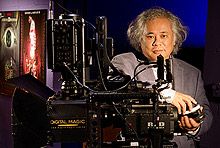
Percy Fung casts a watchful eye over cameraman Li Cheuk Fai, who is hard at work building a new generation 3D camera rig. The hand-built rig, together with Li, will be travelling to Canada later this year to shoot a 3D film.
"This one here," says Fung demonstrating another setup, "will be going to Mongolia next month for filming."
Fung, it seems, has well and truly caught the 3D bug. The 59-year-old founder of Digital Magic - a natural offspring of its parent company Film Magic -- loves talking about movies and the film industry, especially digital video and in particular 3D.
The pioneering Hong Kong film industry entrepreneur got into the movie industry after dropping out of university in 1974. After studying industrial design at Hong Kong Polytechnic University for three years, he found his calling, and just four years later had shot his first commercial film.
Over the past 33 years, he has built up a cluster of subsidiaries to support every aspect of the film industry, from filming, to post production, to screening and even distribution. Despite running a studio, building rigs, editing and offering just about every service anyone needing 2D or 3D -- and more recently 4D -- movies could want, he still finds time to share his experience with students.
"I love teaching young people," the Adjunct Professor for the School of Creative Media at City University of Hong Kong says. "Their creativity and innovative minds keep me young."
When asked how does he find the time? He shrugs and calls his daily itinerary "controlled chaos."
Three dimensional puzzle
In the past two years, his company has provided the expertise to shoot five 3D feature films in Hong Kong and overseas, the most well-known being "3-D Sex and Zen: Extreme Ecstasy," which broke "Avatar's" opening-day box-office record in Hong Kong in April. Another film that had audiences gasping, this time in fear rather than eroticism, was "The Child's Eye."
Besides winning acclaim for being the first truly 3D erotic movie, those in the film industry were also turned on by how completely natural tones, especially skin tones, were, because on digital they can sometimes come across as unnatural compared to film.
"It is not only about having the right equipment, but also knowing what is and is not possible to show in 3D, in addition to post production, even the screening of films. There are so many factors to take into consideration," Fung explained.
As the movie industry is still unsure if 3D is here to stay - and the fact that the technology is constantly evolving -- many film studios are still nervous about investing in the technology and training, which is where pioneers like Fung say they have the advantage.
"I don't know if 3D is here to stay, I do not have a crystal ball. But if companies treat this like a business, and your first movie loses money, you will probably quit and try something else. But film making is more of an art than a business. You have to look to the long-term and sometimes you have to take a risk if you believe that something like 3D will redefine how we watch movies and TV," he said.
By embracing the new technology, he has a first-mover advantage, which is paying dividends for companies looking to produce everything from 3D movies, to corporate promotions, to converting 2D movies into three dimensional reruns.
Within four to five years, industry watchers predict most feature films will be made in 3D, because theatres are making huge investments to be 3D capable. Manufacturers of televisions are also pushing out sets that can show 3D. This in turn is making theatre owners worried that they won't be able to recoup their investments in going digital.
The downside to both cinemas and TV makers is at present there is not enough 3D content for many consumers to justify splashing out on a new 3D home theatre, especially when filmmakers themselves cannot commit to the technology.
"It is really like the chicken and egg case at the moment," he said.
Total immersion
Whether or not people will decide to pay a premium to watch a 3D film in the cinema depends on the experience they are after. The technology is already here, and entertainment is not just about movies anymore. It is about getting closer to total immersion. If you are going to suspend disbelief and become part of an experience - whether that is movies, TV or games - it is going to have to be in 3D.
But some 3D bombs also have Hollywood going back to sit on the fence to see how 3D films evolve. While some movies, most notably "Avatar" and "Alice in Wonderland" had film-makers rubbing their hands at the prospects of ever higher revenue, others -- like "Cats and Dogs" - brought them back down to earth.
Some filmmakers have also charged that 3D movies are expensive to make, and to watch. The cameras are hard to use and the processing of the digital movies needs three-times as long to turn into a finished movie. People are also quite happy to watch a 3D film in 2D, given the fact that many people who have 3D TVs opt to buy a 2D DVD.
However, Fung says the cost of making a 3D film is not much more than a 2D one. The main issue is there is not enough good 3D content available for it to become normal entertainment in people's lives. And there is a danger that bad movies will sour people's interest in the 3D before it becomes commonplace.
Filmmakers complaints about piracy have made them not entirely dismiss 3D technology, which makes it extremely difficult to copy movies. Fung doesn't really see 3D technology as the silver bullet to knock out piracy. Instead, he feels film studios need to charge lower prices and make their movies more easily available to combat pirates.
"For example, if it costs you about $20 to buy a bad copy, and say $50 or $60 to buy an original, who will by a pirated copy?" he asked.
New lease of life
Fung's movie facilities also extend to regular film processing, and also conversion to digital, which is giving old movies a new lease of life. Down the corridors of his studio, technicians huddle in front of screens digitizing movies and reprocessing their colour to make them as clear as the day they were shot.
Releasing old movies on DVD can be a healthy money spinner for film studios and actors. Fung says besides giving new life to old movies, it also ensures they will be seen by many more generations. Some of the films that studios ask him to digitize are straight conversions from film to digital, while others request they be converted into 3D.
By layering 2D movies, they can become 3D, which is helping to build up the range of content that is available. However, a badly converted film can do more harm than good to the wider acceptance of 3D.
"It takes about a month to convert one film, and like I said before it is not simply about having the equipment - the hardware. You really have to know what is and what is not possible in 3D," said Fung.
Looking to the future
Despite the challenges, he remains excited about the future of both digital and film. One of his personal projects involves creating a time capsule and a film archive. While digitizing film would seem to be the obvious solution to achieve this, the life of digital archives is at the mercy of technology. Therefore, he is archiving historic clips, such as the handover of Hong Kong back to China on polyester film, which has a lifespan of between 300-500 years.
Another project is archiving Chinese operas.
"A lot of the traditional operas are disappearing, so we are looking at recording as many of these as we to save them for posterity," he said.
The opera singers can then be depicted performing on a digitally created stage, which could be in the Forbidden City, a local market, or any other setting that the designer desires.
"I love how the only thing that constrains you in this industry is your imagination, it is like magic," he said.
