
LED Up Ltd
- HKGCC Membership No. :
- HKL0535
LED Up Your World
Walk around the floor of Hong Kong International Lighting Fair in April, and you would be forgiven for thinking that lamps based on light-emitting diodes, or LEDs, had already filled our homes and workplaces.
LED bulbs and fixtures dominated nearly every booth on the show floor. Outside of the fair, however, with the exception of traffic lights and the Symphony of Lights extravaganza, LEDs are a rare sight. Now all the world has to do is catch up.
Claire Paris, the Hong Kong representative for LED-Up, a French LED design company, said with costs falling and life-spans of the diodes extending, LEDs will be more common in the office and home in the coming years.
"The price of LEDs have come down a lot, and are now about 20-30% more expensive than regular fluorescent lighting. But when you consider they last up to 100,000 hours, compared to incandescent bulb's lifetime of 750 to 1,500 hours, you probably will not have to change the bulbs for about 20 years," she said. "On top of this advantage, and the most significant, is that they use a fraction of the energy used by incandescent lighting. So although they cost slightly more, the long-term savings are far greater."
Most street markets in Hong Kong now have a few stalls glowing with LED lighting strips, balls, bulbs and wires, which is a clear indication of how much they have fallen in price.
However, many people still think of LEDs as the lights blinking from inside electronic devices. They are being used increasingly to light rooms, though few people have ever bought them.
Bright idea
Amine Belkadi, CEO of Norami Technologies, the parent company of LED-Up, decided in 2005 to venture into the design and development of LED signage and up-market lights for luxury homes, hotels, and even yachts.
The two-man band quickly grew and now employs 40 people at its headquarters in Picardie, northern France.
In July 2008, it decided to establish an office in Hong Kong to tap into the booming Asian market.
"There has been a lot of interest in our products. Although we manufacture a lot of our products in China to keep costs down, they are designed in France which gives us an edge over our competitors," said Paris. "Also, our latest products, decorative LED hoops and tiles for atmospheric and decorative lighting are designed and handmade in France."
While compact fluorescents maybe the standard in most homes today, more designers and architects are rallying around LED lamps for their many applications, as well as more environmentally aware consumers.
Although the word conservation often makes us think of sacrificing something to conserve resources, it is really about getting the same bang for your buck. To make such a point, the Lighting Research Center conducted an experiment with 700 retailers in the United States. The normally energy intensive window displays switched to LEDs. Retailers discovered that they managed to reduce their energy usage by up to 50% when they switched to LEDs to light their store windows without any compromise to the quality of light.
An added advantage is that they can be made in many shapes, sizes and colours, and, unlike compact fluorescent bulbs, they contain no mercury, and provide a more pleasing light than fluorescents. "For example, just for white there are a basic three different shades of white - warm, neutral, cold - depending on your preference," she said.
Strips of flexible LEDs also allows designers to put light in places where it could not otherwise fit, or where the heat generated by regular lights would be a potential hazard, she added.
Much of the home lighting industries' efforts are aimed at making LED lamps that emit as much light as a 60- or 75-watt incandescent bulb. Some LED ceiling fixtures use as little as 6.5 watts to create the light of a standard 65-watt lamp.
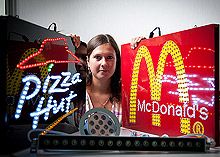
For LED-Up, the company has managed to successfully argued the merits of using LEDs to many household names, such as McDonald's, Pizza Hut, Subway, and Credit Agricole, among others.
"Hong Kong tends to be more environmentally aware and penny wise than many countries, so I think the take up rate will continue to rise as more consumer LED lighting options, like lamps sold in Ikea, find their way into people's homes."
