
Playnote Ltd
- HKGCC Membership No. :
- HKP0554
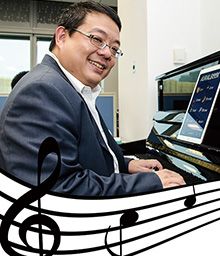
Teaching Music With Technology
“How can I help my music students learn better at home?”
Considering this question was what led Eric Yung – along with a team of professional musicians and technology experts – to found Playnote in 2010. At Playnote, the founders’ musical expertise is combined with technology such as digital signal processing, artificial intelligence (AI) and cloud computing to transform the way students learn and practice music.
Yung was immersed in music throughout his childhood. His talent and hard work paid off, and he achieved the dream of becoming a professional pianist, opera tenor and orchestra conductor, as well as a music teacher.
Outside of music, he studied electronic engineering at university, and later attained a degree in law and a master’s in business administration. This passion for music combined with technological knowledge and business expertise gave Yung a good foundation to pave the way for the success of Playnote.
After two years of research, design, testing and development, the company launched the world’s first patented interactive electronic music book – AURALBOOK – in 2012.
This flagship product is designed to prepare music students for exams in Grades 1-8 by the Associated Board of the Royal Schools of Music (ABRSM). During the aural part of music exams, students may be required to sing or clap a short piece after it has been played by the examiner, and to sing notes from score.
“We have relied on teachers for hundreds of years for singing, clapping and playing the piano,” Yung said.
But through his teaching, Yung realized that it is difficult for students to practice these aural skills without the teacher’s guidance, as it is hard for them to hear any mistakes they might be making. This prompted him to investigate if there was a way to use technology to “hear” student's practice, which led to the development of AURALBOOK.
“The unique ‘electronic ears’ function can identify students’ singing and clapping while the AI system can analyse their intonation, rhythm, speed, tone and singing skills by showing the comparison between the music and the student’s singing and clapping on the sheet music, followed by a human voice pointing out their areas for improvement,” he explained.
Students can simply sing and clap in front of a mobile phone or tablet computer and learn step-by-step with the help of the AI teacher.
“The aural test is actually kind of a mechanical training,” Yung said, adding that it also helps music teachers. “I am facilitating both the teaching and learning process, solving my own problem too.”
In 2016, Playnote went a step further by launching its SCALEBOOK for ABRSM, which can also “listen” to the sound of musical instruments. “Each sound has its own characteristics which can be analysed by AI,” Yung said. “When there is a big fluctuation in the one-second data, it means it has gone off-key.”
To make learning more effective, the AI teacher can also provide a detailed analysis of the students’ strengths and weaknesses, using a simple diagram to assess aspects of their performance including accuracy, intonation and confidence.
Just like AURALBOOK, the dates, time and achievements of every practice and mock exam in SCALEBOOK can be stored in students’ cloud account. A weekly breakdown of their performance based on data collected is provided as well, helping students to understand their progress.
“Not only can they review this information at any time, but they can also share their practice progress with their music teachers through Playnote Organizer,” Yung added.
“The current version supports violin, flute, trumpet, clarinet, alto-saxophone, oboe, descant recorder and treble recorder. The future version will support other music instruments.”
Music is a world language, Yung said, so “any business related to music should go beyond national boundaries.”
Therefore, right from the beginning, Yung positioned Playnote as an international brand that can be used by students worldwide preparing for exams from a number of examination boards. With English, Mandarin and Cantonese versions available, Playnote’s products now serve millions of users.
Making music lessons less of a chore and more enjoyable is also an important part of Playnote’s vision. As Yung puts it: “Changing the boring learning environment in the traditional music education system and enabling more people to enjoy the music learning process.”
Currently, Playnote works with 70 local music centers, stores and schools. In 2016, it launched another product, Rehearsal Partner, which helps students preparing to compete in the Hong Kong Schools Music Festival.
By leveraging AI technology to restructure the traditional way of learning music, Playnote has gained footholds successfully in both local and global music education sectors, including in the U.K. and Australia. Both AURALBOOK and SCALEBOOK have won awards, including the Hong Kong ICT Grand Award, the Asia Pacific ICT Award, and the Innovation and Creativity Award at the Hong Kong Awards for Industries, which is sponsored by HKGCC.
But technology will not do away with the need for real life musicians, Yung said, as expressing feelings and emotions is an essential part of performance.
“Would you pay for a concert to watch a robot playing the piano?” he asked – the answer is an absolute no.
Company: Playnote Ltd
HKGCC Membership No.: HKP0554
Established: 2010
Website: www.playnote.com
