
Grand Wine Cellar
- HKGCC Membership No. :
- HKG0550
Winemaking is Still More Art than Science
The boom in demand for wine, and willing connoisseurs ready to part with serious money to buy a prized bottle, has grown a marketplace obsessed with trying to scientifically quantify the components that make up a truly excellent wine. But as any winemaker will tell you, many of the factors that determine a good wine are in the hands of Mother Nature.
Each bottle of wine that you contemplate buying could have faced inclement weather, or perfect growing conditions. But in the past few years, Europe’s winemakers have had to deal with disastrous weather that has seriously damaged their grape harvest.
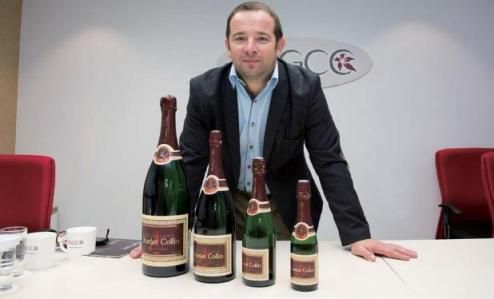
As part of consumers’ growing interest in not just appreciating wine, but learning about its producers, Chamber member Grand Wine Cellar invited Cecile Chenu-Repolt (below) of Louis Max, and Sebastien Petiteaux (right) of Champagne Charles Collin to Hong Kong to discuss their wines. While in town, they spoke with The Bulletin about winemaking, their involvement in Hong Kong business and also the challenges they face.
“Winemaking depends heavily on external factors: the climate, temperature, soil, wind – any one of these elements can ruin your bottle of wine, explained Chenu- Repolt. Pinot Noir, a major component of Louis Max and Champaign Charles Collin’s range, is even sensitive to external factors because of the nature of the grape. “A hailstorm in Burgundy in July 2012 resulted in catastrophic damage to the crops,” she said. “There is a 50% reduction in production, especially for the white wine.” Halving of production could not have come at a worse time, as demand for wine, and in particular champagne, has been skyrocketing. But Petiteaux said despite supply being down 50%, “It is not possible for us to increase the price by 50%.”
She is also worried about the coming years, because a significant decrease in wine production will also impact production over the next three to five years.
To overcome low supply amid high demand, their strategy is to produce high quality wines and limit distribution. Hong Kong has no shortage of wines, so it is difficult for newcomers to stand out.
“Hong Kong is a very mature market and the people are very educated about wines and champagnes,” said Petiteaux. “So you need to surprise them, but it is more and more difficult to surprise them.”
To promote its brand and to make it more exclusive for high-end customers, it has been distributing its wines to many top restaurants and luxury hotels. Champagne Charles Collin, on the other hand, has created exclusive and premium products, such as vintage champagne or large volume champagne. “We are not trying to make regular champagne, because you can get it everywhere,” Petiteaux said.
Both Chenu-Repolt and Petiteaux value the Hong Kong wine market, not only because people here are very educated and interested about wine and champagne, also because Hong Kong serves as a “showroom” for Mainland wine lovers.
“People from China will come to Hong Kong and taste the exclusive, top level wines and champagnes. And if they like them, they will bring them home, so Hong Kong is like a shop window for them,” explained Petiteaux.
When asked about their predictions for coming vintages, both agreed that it is like predicting the lottery.
“Everybody likes to talk about long term, but nobody can even say what will happen tomorrow,” Petiteaux said.
He highlighted that despite all the technology, tests, and theories in the world, winemaking is still an art, and its artisans are at the mercy of the weather from day to day. But he added that he is still very positive about the wine and champagne business, because around the world production is increasing to meet demand from the growing numbers of “art lovers.
