
PH Paris Ltd
- HKGCC Membership No. :
- HKP0562
Little Bites of Happiness
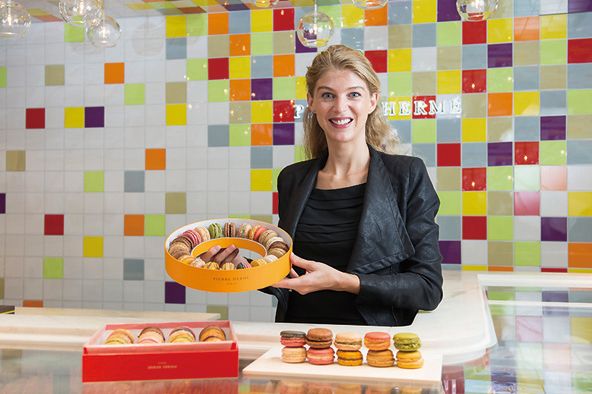
A heavenly aroma drifting from the increasing stream of boutique boulangeries, confectionaries and dessert shops opening in Hong Kongis tempting more people to try new and often exciting gourmet delights. Not least is renowned French patissier and macaron maker Pierre Hermé. When he first opened his doors last summer, people queued for hours just to sample his macarons, famed for their unconventional flavour combinations.
“We chose to come to Hong Kong because people here are already extremely knowledgeable about macarons,” said Julia Cordier, General Manager of Pierre Hermé Paris, Hong Kong. “Most of our customers on opening day already knew about Pierre Hermé and the brand, so they were excited to finally have it here in Hong Kong.”
She also credited Hong Kongcitizens’ enthusiasm for embracing new foods, and being open-minded enough to try flavour combinations that are out of the ordinary.
Balancing Tradition and Innovation
The macaron industry is entrenched in tradition, with renowned producers like Fauchon and Ladurée sticking to tried and tested flavour combinations for over a century. Pierre Hermé then is like a breath of fresh air, as he has brought an innovative approach to the industry, while maintaining respect for the art of macaron making.
Although something of a self-indulgent luxury, his store lacks the pretentiousness that comes with some luxury confectionaries. Chocolates, cakes and teas are laid out on simple shelves, while stacks of macarons are displayed in glass cases, creating a clean, casual atmosphere.
Regarded as “The Picasso of Pastry,” Pierre Hermé first entered the pastry industry when he was 14, working under Gaston Lenôtre as an apprentice. Afterwards, he worked in both Ladurée and Fauchon, then decided to create the Pierre Hermé Paris brand together with partner Charles Znaty, which eventually lead to an invitation to open his own store in the New Otani Hotel in Tokyoin 1998. In 2001, he established his first store in Parisat rue Bonaparte, and quickly rose to prominence for his bold and innovative approach to macarons.
According to Cordier, Pierre Hermé is one of the first people to incorporate multiple flavours in a macaron. These include his legendary Ispahan creation, which combines rose, raspberries and lychee flavours into a single macaron, giving gourmets multiple bursts of flavours in a single bite. Other combinations, like beetroot and liquorice, olive oil and vanilla, and white truffle with hazelnut are rapidly snapped up by eager customers.
But how does Pierre Hermé receive inspiration for such unique flavour combinations? “Pierre Hermé is an artist,” answered Cordier, “He gets inspiration everywhere. He reads a lot, goes to museums, looks at art, constantly traveling, and from these experiences he draws inspiration. He sketches out recipes which he’s created in his mind, then develops it with his team of pastry chefs.”
While some of Hermé’s flavour combinations may sound strange to some people, he has one golden rule which he will never break. “He will never make a savoury macaron,” said Cordier, “Even foie gras and chocolate, a savoury sounding combination, stems from the idea that foie gras has an innately sweet, buttery taste which complements an almond biscuit and some acidity and fruitiness of good quality chocolate.”
Pierre Hermé’s approach to macaron flavours may be unusual, but his continued pursuit for perfection is the same as his predecessors. Before going on sale, each new flavour is extensively tested to ensure the combinations satisfy the palate of Pierre Hermé.
“To ensure that each macaron is of the highest quality, they are made in Franceand imported to Hong Kongunder very controlled handling,” Cordier said. “By following strict procedures during production and transportation, the same quality and consistency can be maintained globally. So every Pierre Hermé Paris macaron that you try, no matter where, will be exactly the same!”
“There is no secret to making a perfect macaron. Our macarons follow the same recipe as those published in Pierre Hermé’s recipe books. The trick is to follow every step of the instructions exactly, ensure that the measurements are precise and practice constantly,” she said.
However, one cannot help but be a bit sceptical with this claim after eating a Pierre Hermé macaron, as those “little bites of happiness” taste too sophisticated for a home cook to replicate.
Sweet Prospects
For the past few years, demand for macarons and other gourmet treats have led to the entry of many luxury retailers opening in Hong Kong, such as Fauchon in 2012. This, coupled with emerging local brands, has result in an extremely competitive industry. Despite being new to the Hong Kongmarket, Cordier is confident their product will ensure their success.
While food trends can come and go quickly in a city like Hong Kong, Cordier says Pierre Hermé Paris is here to stay. “Macarons created by Pierre Hermé are limitless. Pierre Hermé has developed many other products which constantly intrigue our customers. Even chocolates, pound cakes and candies have iconic flavours” she said.
She expects exciting times ahead for Pierre Hermé Paris, with the brand planning to open more boutiques to take advantage of Hong Kong’s hunger for delicate confectionary treats. The company will also introduce new flavours, such as its Veloutés collection, a series of macaron flavours which taste just like fresh yoghurt.
Pierre Hermé’s dedication to perfection comes at a lofty price, with a 7-piece box of macarons costing HK$220, but one which Hong Kongcitizens are willing to pay.
